
Who Are We?
My MissioN
This site is an opportunity for me to share my observations with others. It doesn’t mean I’m right but I’m always trying to push the perspectives I use so I can understand how we can collectively make the biggest impact in our society. My thought process is framed by my direct experiences, what I’ve learned from others and most importantly grace.
Huovinen: The last name Huovinen is of Finnish origin, primarily found in Finland and among Finnish communities worldwide. It is derived from the Finnish word “huovi,” which means “herdsman” or “shepherd,” indicating that the name likely originated as a designation for individuals who tended to livestock, reflecting an occupation closely tied to rural life and agriculture. The suffix “-nen” is a common diminutive or patronymic ending in Finnish surnames, suggesting a familial or locational connection. Variations of the name may include Huovi or Huovila, which can be found in different regions or among Finnish-speaking populations. The name Huovinen is relatively unique to Finland, and while it may not have widespread variations in other languages, its roots in pastoralism highlight the importance of agriculture in Finnish culture and history.
My Origin Story
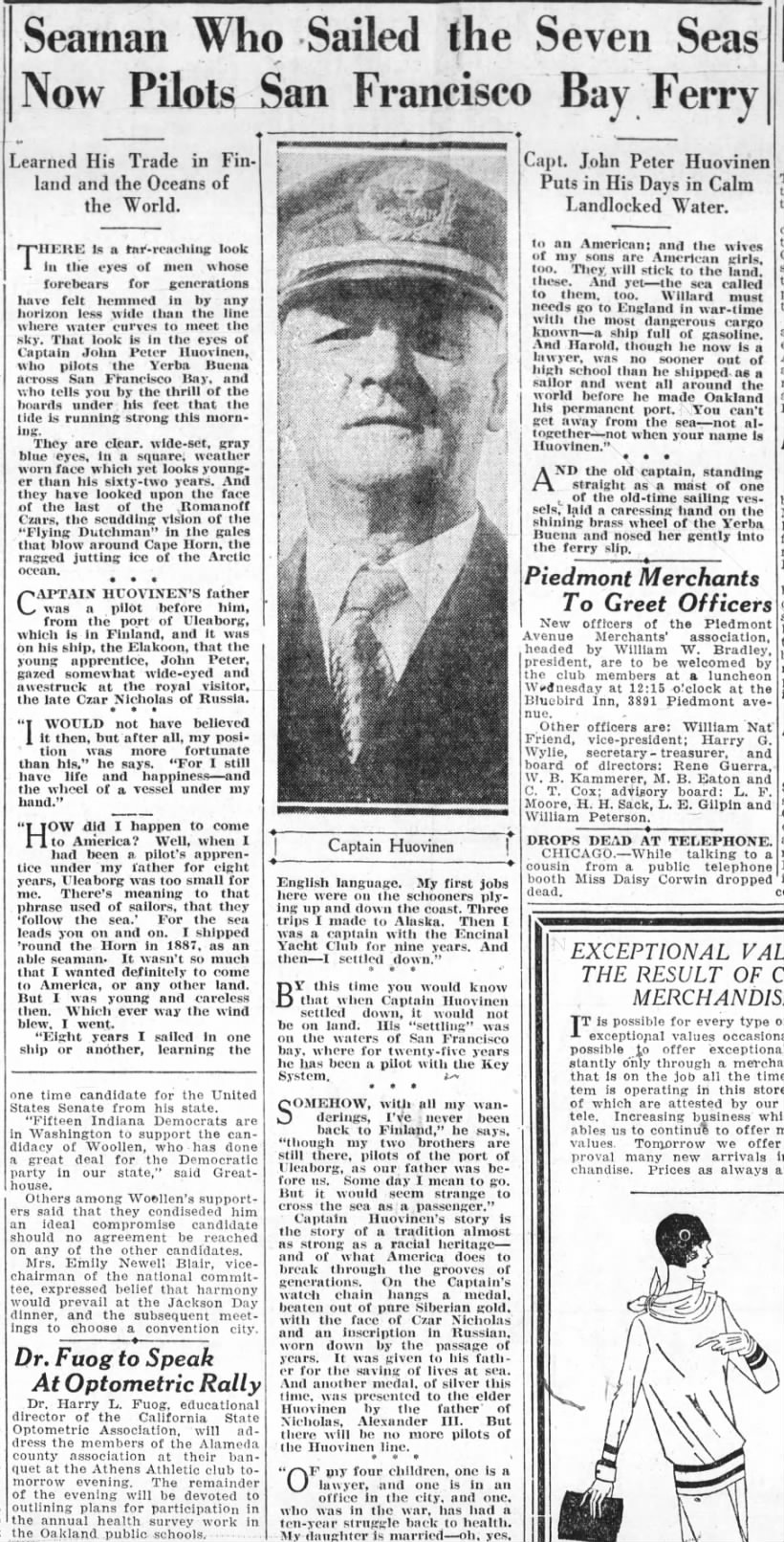
We all have stories. The surnames of my parents are Huovinen and Sequiera. Yes, neither is very common. There are other names and relatives that have been in the United States much longer such as Wilson, Franklin, Hoffman and Kuhn but I want to share the more recent histories first.
The following is from the Oakland Tribune dated January 10, 1928. I encountered this only a few years ago and what I love most is seeing the oral stories that I had heard from my grandparents in the 1980s expanded upon in print.
My mom and her family, specifically the Sequeira’s, also had their own history of immigration.
History of the Sequeira Dairy
Written transcription from oral history given to Carol Sequeira from Marie Sequeira Balshour.
Penalva do Beira – Alta, Portugal was the home of Maria Jose Grilo Sequeira – my father’s mother and my (Carol Sequeira) grandmother. My grandmother was one of 16 children born on June 24, 1894. She married Salvadore Sequeira. He was two years younger. They were in love, but Salvadore had to go into the militia for two years. Maria waited for him. They were married in 1921. My father Leonard Joseph Sequeira was born April 10, 1921 in Portugal. (My grandmother Maria and grandfather Salvadore may have been first cousins.)
Coming to America
Salvadore Sequeira, my grandfather, had 3 brothers – John, Jose, and Leonard – and at least one sister, Ana.
From tombstones at Silveyville Cemetery:
- John A. Sequeira – 1882–1961
- Jose P. Sequeira – 1891–1931
- Salvadore J. Sequeira – 1897–1931
- Leonardo Nascimento Sequeira – 1905–1967
- My grandmother: Marie J. Sequeira – 1894–1952 (died in Portugal on a vacation
at 58 years)
His oldest brother – 1882 – Uncle John – was in the militia for two years but never learned to read or write his name. Amazingly, he was the very adventurous one and came to the U.S. in 1911 at the age of 29 years, all alone. He got a job in NY making toilets. The first winter he had a beard and it froze. He decided there must be something (someplace) better, so he hopped on a train and headed west. He went as far west as the train would go. It could have been Sacramento. Somehow he got to Gridley. He got a job milking cows. Uncle John got someone to write for him and sent a letter back to his family. His brother Jose (Joseph) showed interest in coming to America. Uncle John saved enough money to send for him.
5 years later Uncle Joe (Jose) landed in Concord, CA. Uncle Joe knew how to sign his name and Uncle John and Uncle Joe corresponded by letter. Their goal was to send for the other two brothers – Salvadore & Leonard N. Uncle Leonard N’s mother had died during childbirth or right after. Uncle Leonard’s sister Tia Ana raised him until he was 16 years old. He always felt grateful to his sister – Tia Ana.
1921
My grandfather Salvadore, my grandmother Maria, my great Uncle Leonard N., and my father Leonard Joseph came to the U.S., probably July–August 1921. Dad (Leonard Joseph) was only two months old. I think they went through Ellis Island. They took a steam train west to Sacramento. The steam train produced a lot of soot. Dad got covered in soot and grandmother Maria said she could only see his eyes when he woke up from a nap.
The four brothers ended up in Gridley, CA. All were milking cows. In Biggs, CA they bought a dairy farm. Someone lent them a
cow which they were supposed to pay back. They did not stay in Biggs very long. They then moved to a place near Elk Grove on Sheldon Road. They went into partnership with Mr. Sousa, near Consumnes River. Mr. Sousa and Uncle John had a big fight about the partnership. Mr. Sousa had a daughter and he hit her over the head with an umbrella. Police came. The Sequeira brothers bought a pistol out of fear and then filed bankruptcy.
The Sequeiras contacted a lawyer – Mr. Joe Mento. Joe Mento drew up bankruptcy papers which divided up the joint property (with Mr. Sousa)
– the land, the cows, etc.
While in Elk Grove, Uncle Leonard went to school – Lieber School. He was about 16–17 years old.
In 1923, while in Elk Grove, grandmother Sequeira gave birth to a stillborn girl. Dr. Cross from Courtland attended the birth.
This baby girl was buried at a cemetery at 21st & Broadway in Sacramento. All the babies are buried there. Around that time, the cows that belonged to the Sequeiras were in a cattle drive over the M St. bridge and the causeway.
1924–1925
They settled briefly in Yolo Co. near Putah Creek. Then they moved to a place on Sievers Road – a shack – where Aunt Marie was
born. Dr. Flewitt delivered her. (I remember Dr. Flewitt.) Aunt Marie was born on March 26, 1928. When Aunt Marie was two weeks old, they moved to the Watson Ranch, where they settled 160 acres.
1931
My grandfather Salvadore and his brother Joe (Joseph) contracted pneumonia and died within a two-week period. Uncle Leonard and Uncle John carried their brothers in a blanket through the house trying to force air into their lungs. My dad was 10 years old. The sound of the “death rattle” from his father and uncle remained in his mind his whole life.
At 10 years of age, my dad assumed a huge responsibility on the dairy. At the time of my grandfather’s death, Uncle Leonard N. and Uncle John promised to provide food and shelter for my grandmother, my dad, and Aunt Marie (2–3 years old). The promise also included that my grandmother would not have to do field work. Grandmother Sequeira cooked, cleaned, and did laundry for the uncles and her own children in exchange.
As a result of the promise neither Uncle Leonard nor Uncle John married. The promise was kept – the honorable thing done!
Because of Salvadore and Joe’s deaths, the family had to leave the Watson Ranch.
1932–1933
The U.S. country was still in depression. There were a lot of Portuguese in and around Dixon, CA. Angus Madden (outstanding businessman in Dixon
who was on staff of the First National [Northern] Bank until his death in 1945) loaned money to Leonard Sequeira on a handshake/note.
The Sequeiras paid back every penny from the bankruptcy in Elk Grove for the original 40 acres. Mrs. Almeida, from Crockett, CA, sent Leonard the money for the additional 40 acres. These 80 acres constituted the Sequeira Dairy on Pedrick Road. Note: Eduarda was Mrs. Almeida’s first name.
The Sequeiras (Uncle Leonard, Uncle John, Grandma S., Dad & Marie) moved to the dairy on Pedrick Rd.
Angus Madden (from Roberta Wallace) had a deep belief in education and the future generations. As a result, a memorial fund (scholarship) was set up to help college-bound students. I (Carol Sequeira) received an Angus Madden Book Scholarship in 1983 and Heather Huovinen (my daughter) received an Angus Madden Scholarship in 1995.
Info – Angus Madden
- B. 1888 – early settler in Dixon
- Lived on S 1st St.
- Graduated from UC Berkeley
- Married Grace King – another pioneer family
- They had 3 kids
- Angus was employed by W.J. Wynn Meal Alfalfa Company
- From 1926–1945 he was on staff at First N. Bank
Misc: Hans Rohwer was a good friend of the Sequeiras. He had 2 dogs – Duke & Fred.
1952
Grandmother Sequeira & Mrs. Almeida went on a vacation to Portugal – Grandma’s first visit to her home since 1921. Grandma died unexpectedly there
from an undiagnosed cancer. Before leaving for the trip, Grandma Sequeira took a family picture with her. Many years later this picture would help identify our Portuguese relatives.
Shortly after getting to Portugal, Grandma Sequeira & Mrs. Almeida were going on a morning walk. When Grandma Sequeira didn’t come
downstairs, Mrs. Almeida discovered she had died. Grandma Sequeira was buried within a few days – probably before anyone in the U.S. knew she had died.
Dad & Aunt Marie heard the news; a request was made to have the body exhumed and shipped to Dixon. A few months later there was a
funeral service for her in Dixon. There was a lot of difficult legality over the exhumation. Grandma Sequeira is buried in the Silveyville Cemetery near Uncle Joe & her husband Salvadore.
I was six years old. I loved my Grandmother Sequeira very much. I remember her kindness – once teaching me to say my prayers in Portuguese, her home-made bread, the homemade linguica she made me for my 5th birthday which was my height, the chicken soup with all the different sized eggs in it, the fishcakes, the home-cured olives, picking beans under the trellis in the garden, feeding the chickens, etc.
(TO BE CONTINUED…)
Extraordinary Experiences
What are your personal experiences that shaped you growing up or perhaps you learned of these after were were already grown. Who you are is not static. You always have the ability to change who you are, grow and establish your own identity and own set of unique experiences that will become your legacy.